
A message from 1995
A 30th anniversary appreciation of Martin Amis's The Information

Two very important people in my life turned thirty in 2025. One is my son, Sam. The other is a failed literary novelist named Richard Tull.
The first is a man with many admirable qualities: kindness, loyalty, resilience, curiosity, courage. The second is a man of deeply flawed character who has a very small number of redeeming features, chief among them that he’s the protagonist of Martin Amis’s 1995 novel The Information.
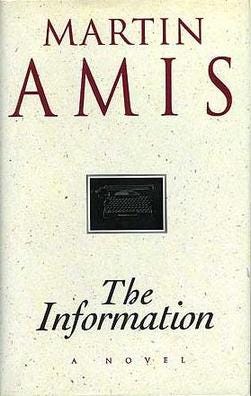
They are connected by the fact that, when my wife went into labour and I grabbed the bag of things to take to the hospital, I tossed in Amis’s latest novel in case I found myself with a bit of downtime. (Reading time turned out to be scarce, but eventually, when mother and child were both asleep, I got through a few pages.)
In the novel, Richard Tull is five years older than I was that June of 1995, though with twin six-year-olds, he became a father at about the same age as me. So, on the cusp of middle age as I was, I could not help but sympathize with Richard’s feelings of decrepitude and his premonitions of death. Impending fatherhood brought with it the fear that work and parental and financial obligations would occupy all of the next few decades of my life, until I slid towards old age. As a result, the novel grabbed me right from this early line:
“He awoke at six, as usual. He needed no alarm clock. He was already comprehensively alarmed.”
Perhaps anticipating the weight gain that would accompany the first years of fatherhood and the accelerated retreat of my hairline, I laughed with Richard, rather than at him, when I read: “Looking in the mirror now, on the morning of his fortieth birthday, Richard felt that no one deserved the face he had. No one in the history of the planet. There was nothing on the planet it was that bad to do.”
I have perhaps introduced this novel in the wrong way. Yes, it’s a darkly hilarious novel about a literary mid-life crisis and the fragile masculinity upon which such crises depend. Yes, it’s a novel of men behaving badly, which was a specialty of Martin Amis and of his father, Kingsley. (It contains passages on hangovers that might only be surpassed by the memorable line in Kingsley’s Lucky Jim: “His mouth had been used as a latrine by some small creature of the night, and then as its mausoleum.”
But for readers who don’t have my unusual personal connection to it, The Information is worth reflecting on now, thirty years later, because it may be the high-water mark of a particular kind of fiction: erudite, playful, unconcerned with morals or with improving or condescending to the reader and unabashedly heterosexually male. You didn’t read The Information to become a better, more empathetic person or to empower more diverse voices or to speak truth to power or for help healing from your traumas. You read it to see what Martin Amis could do with words. And perhaps, to be honest, because you hoped some of Amis’s glamour might rub off on you, near the end of an age when “glamourous literary novelist” was not a contradiction in terms. As such, it’s an artifact of a literary world that has been largely obliterated over the past three decades.
When I first read The Information, I was working in public relations, after an earlier and not very distinguished career in journalism. I still dreamed that I would get back to writing fiction, as I had attempted several times in my teens and twenties, and figure out how not to embarrass myself. Over the next thirty years, improbably, I did manage to have a pair of novels and a clutch of short stories published and see a few of my plays produced. For a dozen of those years, I also found myself employed part-time as a newspaper columnist covering the literary world. Like the protagonist of The Information, I have dwelt for many years on the fringe of the literary world. All of that made rereading The Information in preparation for this anniversary feel like revisiting the words of a prophet, or perhaps like opening a time capsule.
The central conflict in The Information is between Richard Tull, a writer of such challenging modernist fare that his books tend to cause brain injuries in those who try to read them, and his rich and successful novelist friend Gwyn Barry, who writes simplistic, optimistic, race- and gender-diverse novels of the sort that we might today call “hopepunk.” Gwyn’s novel Amelior, about a racially diverse group of men and women rebuilding the world into a sort of new Eden, is a global sensation. Richard doesn’t get it.
“When he first read Amelior, Richard kept forgetting what he was doing and kept turning abstractedly to the back flap and the biographical note, expecting to see something like Despite mutism and blindness, or Although diagnosed with Down’s syndrome, or Shrugging off the effects of a full lobotomy . . . Amelior would only be remarkable if Gwyn had written it with his foot.”
Despite their lack of literary merit, as judged by Richard, Gwyn’s novels make people feel good and perhaps more important, feel that they are good. Richard, on the other hand, “didn’t want to please the readers. He wanted to stretch them until they twanged.”
Richard’s ambition – to create work that places him in the pantheon of greats – seems a little archaic in this era when we don’t trust pantheons and when so many writers are striving to be representatives, rather than demi-gods. We live in an age when Goodreads gives us, as of this writing, 188,893 one-star reviews of Catcher in the Rye and when asking “what is the most over-rated book?” is a sure-fire trick of social media engagement farmers seeking quick clicks.
“He was trying to write genius novels, like Joyce,” writes Amis, who then concedes: “Joyce was the best yet at genius novels and even he was a drag about half the time.”
The last thirty years have been tough on men wanting to write “genius novels.” Some, like David Foster Wallace, have been consigned to the list of bad and abusive men. Some of his contemporaries or successors, like Jonathan Franzen, have been elevated and immediately dismissed by wide swaths of the literary world as out-of-touch elitists. Another, Salman Rushdie, after spending years in hiding, got a knife in the eye when he tried to return to normal life. Those earlier writers that Amis revered, like Saul Bellow, John Updike and Vladimir Nabokov, are thought of (when they are thought of at all now) as figures of a distant past.
So it’s difficult to remember the status Amis had at the time of The Information. This was a novel – a thick, literary novel – that made the gossip pages on both sides of the Atlantic. It was reported that Amis had left his former agent (Pat Kavanagh, wife of his novelist friend, Julian Barnes) to sign with the American Andrew Wylie and had then received an almost-unheard-of advance of £500,000. There was considerable resentment over this, including over the reported fact that he used some of that money to fix his teeth and acquire an American smile, something he wrote about in excruciating detail in his 2000 memoir, Experience.
Can anybody imagine an international dust-up like that over a literary novel today?
Of course, in the years since The Information there have been many writers for whom £500,000 is chump change, but most of them have been creators of YA franchises. At any rate, in this novel of literary jealousy and resentment, it’s not the money that matters. Richard doesn’t think a lot about his finances, but when it comes to artistic reputation, his ambitions are limitless.
“Like all writers, Richard wanted, and expected, the reverence due, say, to the Warrior Christ an hour before Armageddon.”
So naturally, as a frustrated genius watching a talentless friend get showered with undeserved adulation, Richard spends hundreds of pages in The Information attempting to destroy Gwyn, physically (hiring a deranged street thug known as Scozzy, who, it turns out, is the only person to actually enjoy Richard’s work) and professionally (attempting to sabotage Gwyn’s chance to receive a grant that makes a McArthur Fellowship seem like a nice pat on the back.)
Richard has allowed his resentment to drive him crazy, but Amis provides some justification for Richard’s feelings, if not his actions.
“And writers should hate each other, Richard naturally believed. If they mean business. They are competing for something there is only one of: the universal. They should want to go to the mat.”
The actions that follow Richard’s decision to “go to the mat” are complex and hilarious and create most of the novel’s plot, but plot’s not really what a Martin Amis novel is about. Like his other work, The Information is a linguistic gymnastics act. The delight of the novel comes from watching Amis launch a sentence or paragraph and then waiting to see if he can stick the landing. Here, for example, is Amis describing the once-promising, now downwardly mobile, neighbourhood that is home to the Tull family:
“Offered gentrification, Calchalk Street had said – no thanks. Instead, it reassumed a postwar identity of rationing and rent books. Offered colour, it stayed monochrome; even Asians and West Indians who lived there had somehow become Saxonized – they loped and leered, they peed, veed, queued, effed and blinded, just like the locals. Calchalk Street had a terrible pub, the Adam and Eve (the scene, for Richard, of many a quivering glassful), and a terrible sub post office, outside which, at eight o’clock every weekday morning, a queue of Hildas and Gildas, of Nobbies and Noddies, desperately coalesced, clutching forms. There were Irish families crammed into basements, and pregnant housewives chain-smoking on the stoops, and bendy old men in flares and parched gym shoes drinking tinned beer under the warm breath of the coin-op. There were even whores, up there on the corner – a little troupe of them. Richard moved past these young women, thinking as he always thought: You’re shitting me. In parkas, in windbreakers, grim, ruddy, they presented themselves as socioeconomic functionaries. For money they kept the lid on men in cars.”
Could a writer in 2025 get away with such a description, cramming so much potential offence on class, racial and gender grounds, so much, as we say in the third millennium, “punching down,” into a single paragraph? And how many writers would gamble that readers would stay with a book for page after page of such baroque jokes and twisting ironies (in Calchalk Street, the problem with immigration is that the newcomers have descended to the level of the old stock).
Not that a writer in 2025 would want to take on such challenges. We aren’t in the same game as Amis these days. Now we’re elevating voices, validating experiences. We are the heirs not of Richard Tull and his brain-breaking word games but of Gwyn Barry and his inclusive vision of a better world.
It might be tempting to imagine Richard in therapy. He’s impulsive, self-destructive and certainly an alcoholic. In an age when many writers list their DSM diagnoses on their Twitter profiles, you could imagine a Bizzaro World version of The Information that’s all about Richard’s search to understand and heal the traumas that have made him a monster. (Maybe after realizing that she has internalized the publishing industry’s misogyny, Rikki Tull becomes friends with Gwyneth Barry?)
Amis does suggest factors that may have contributed to Richard’s mental crises. Like his creator, he is obsessed with astronomy and physics and their offspring, nuclear weapons. Nuclear anxiety saturated Amis’s dark 1989 novel London Fields, and it’s always hanging around in The Information, as in this description of an American publicist:
“Phyllis seemed to be the kind of American woman who had taken a couple of American ideas (niceness, warmth) and then turned up some dreadful dial, as if those qualities, like the yield of the hydrogen bomb, had no upper limit.”
But it’s not so much anxiety about humanity destroying itself that has Richard on edge. He’s obsessed by the idea that it doesn’t matter one way or another.
Throughout the novel, we hear about Richard’s unwritten book of literary criticism, which he calls The History of Increasing Humiliation.
“It would be a book accounting for the decline in the status and virtue of literary protagonists. First gods, then demigods, then kings, then great warriors, great lovers, then burghers and merchants and vicars and doctors and lawyers. Then social realism: you. Then irony: me. Then maniacs and murderers, tramps, mobs, rabble, flotsam, vermin.” (Amis’s most memorable work was about the latter group.)
Richard blames this long decline on astronomy. “The history of astronomy is the history of increasing humiliation. First the geocentric universe, then the heliocentric universe. Then the eccentric universe – the one we’re living in. Every century we get smaller.”
Richard wants to be a giant, but lives with knowledge of the cosmic-scale insignificance. (Amis mocks Richard’s own ambitions by giving the novelist a sideline reviewing monstrously thick biographies of the most obscure 17th and 18th century British poets, as if to say “there’s literary immortality for you.”) Our cosmic insignificance is the information delivered in The Information.
At this point, if you remember the opening paragraphs of this essay, you may be thinking: “And that’s the book you brought with you when you were about to witness the miracle of life? What the hell is wrong with you?”
And if you are thinking that, you are not wrong to do so. Cosmic insignificance is not a great thing to have on your mind when you are a new parent charged with care of a fragile young human being. Your job now requires that you act as if things do matter a very great deal. As much of a drunken, resentful, unfaithful failure as Richard may be, Amis does manage somehow to paint him as a loving father. Indeed, to the extent that redemption is a quality that fits in a Martin Amis novel, Richard’s redemption only comes through his love for his sons.
When I read The Information, as a brand-new father, as somebody who still had half-assed dreams of literary greatness, I was well aware that the mood of the novel was very much in conflict with the approach to life I would need over the years ahead. To be a good parent, you must be present, in the moment, fully engaged with the small, growing lifeform that depends on you. To be a good writer, you must be absent, in other times and places, fully engaged with words and concepts that exist in an artificial world.
Amis, a father five times over who once described becoming a grandfather as “like getting a telegram from the mortuary,” no doubt wrestled with this conflict himself. His memoir Experience, published in 2000, explored the challenges in his own life brought on by his father’s preoccupation with the world of words. (As an adult, he recalled being molested by a guest at one of the drunken parties hosted by his father.)
And yet he nails the conflict that exists in the heart of any artist – any artist who, like Richard Tull, is serious about grasping hold of the universal.
Asked by his long-suffering wife if perhaps he should give up trying to write those “genius novels,” Richard replies that he can’t:
“Because … because then he would be left with experience, with untranslated and unmediated experience. Because then he would be left with life.”
Much of Richard’s trouble is caused by his inability to live an unmediated life in the mid-1990s, a decade before Facebook and other social media made it impossible for all but the most stubborn Luddite to live an unmediated life.
Richard’s resentment at the popularity of Gwyn’s writing may be extreme, but it’s a sentiment shared by hundreds of millions of us, when we see somebody else’s snappy remark or holiday snapshot receive an undeserving number of likes. We know it’s bad for us, but we can’t stop. We’re all Richard Tull. And as a writer of fiction who collects dozens of rejections every year from literary magazines and short story competitions, I am especially prone to see Richard Tull’s horrifying face in my mirror.
My happiest moments – many of them spent with my son with no books in sight – have occurred when I have been “left with life” on a mountain trail or a body of water or just in a city park with a ball or a critter-catching net. When I’ve been happiest, I haven’t given a thought to how my happiness might look, what camera angle would best capture it. And yet my life would be diminished intolerably if I were barred from translating and mediating experience. My own attempts to grasp the universal have been received with only a little more enthusiasm than Richard Tull’s, but they are mine and I treasure them. I couldn’t give them up for more pure, unadulterated life. That unresolvable conflict and strange stalemate between art and life is another piece of information I take from The Information.
Great essay. Reading your review of The Information and the literary zeitgeist of those times was like peeking into a time capsule.